What is it?
A brow lift—also called a forehead lift—is a surgical procedure that gently elevates the eyebrows to restore a more youthful, relaxed appearance to the upper face. Over time, gravity and natural changes in skin elasticity can cause the brows to descend, leading to forehead lines, heaviness over the eyes, and an appearance that may look tired or stern.
Dr. Dimitrios Motakis approaches brow lift surgery with a focus on balance and natural anatomy. The goal is not dramatic change, but subtle correction—restoring harmony to the upper face while preserving natural expression.
How does it work?
Several surgical techniques may be used, depending on the patient’s anatomy and goals:
- Endoscopic Brow Lift: The most common modern approach, using small incisions hidden within the hairline and a specialized camera to gently reposition tissue and muscles.
- Temporal or Lateral Lift: Focused on the outer portion of the brow for patients seeking subtle elevation and smoothing of crow’s feet.
- Traditional (Coronal) Lift: Reserved for cases requiring more significant repositioning, with incisions placed across the hairline for comprehensive rejuvenation.
Each technique repositions underlying muscle and tissue, smooths forehead creases, and lifts the brow to its ideal height while maintaining natural movement and expression.
The procedure typically takes one to two hours under general anesthesia or intravenous sedation, depending on the approach. Incisions are placed to be well-concealed, and Dr. Motakis uses meticulous closure techniques to minimize visibility.
Recovery and downtime
Most patients experience mild swelling, tightness, and a feeling of forehead heaviness for the first week. Discomfort is well-managed with prescribed medication.
Initial recovery takes approximately 7–14 days, after which most patients return to regular activities. Exercise should be avoided for two to three weeks. Swelling gradually resolves, and final results continue to refine over several months.
Incisions are hidden within the hairline or natural creases, and with proper care, scars fade to near invisibility. Patients often describe looking subtly rejuvenated and well-rested—without obvious signs of surgery.
Frequently Asked Questions
Who is a good candidate for a Brow Lift?
Candidates typically notice drooping brows, forehead creases, or heaviness around the upper eyelids that make them look tired or stern. A brow lift also helps address asymmetric brows. The procedure is suitable for those in good health seeking a natural, refreshed appearance.
How long do results last?
Results are long-lasting—typically 10 years or more—depending on genetics, lifestyle, and skin quality. While aging continues, patients maintain a more youthful brow position and smoother forehead for years.
Will it change my facial expression?
No. Dr.Motakis' approach prioritizes balance and authenticity. The goal is to restore your natural, relaxed expression—not to create a surprised or overly elevated look.
What kind of anesthesia is used?
Most Brow Lifts are performed under general anesthesia.
Can a Brow Lift be combined with other procedures?
Yes. Brow Lifts are often combined with Eyelid Surgery (Blepharoplasty) or deep plane face and neck lift procedures for comprehensive facial rejuvenation.
What is the downtime?
Most patients return to light daily activity within 1-2 weeks and to full activity within three weeks. Residual swelling, tightness or numbness resolves gradually, revealing refined, natural results.
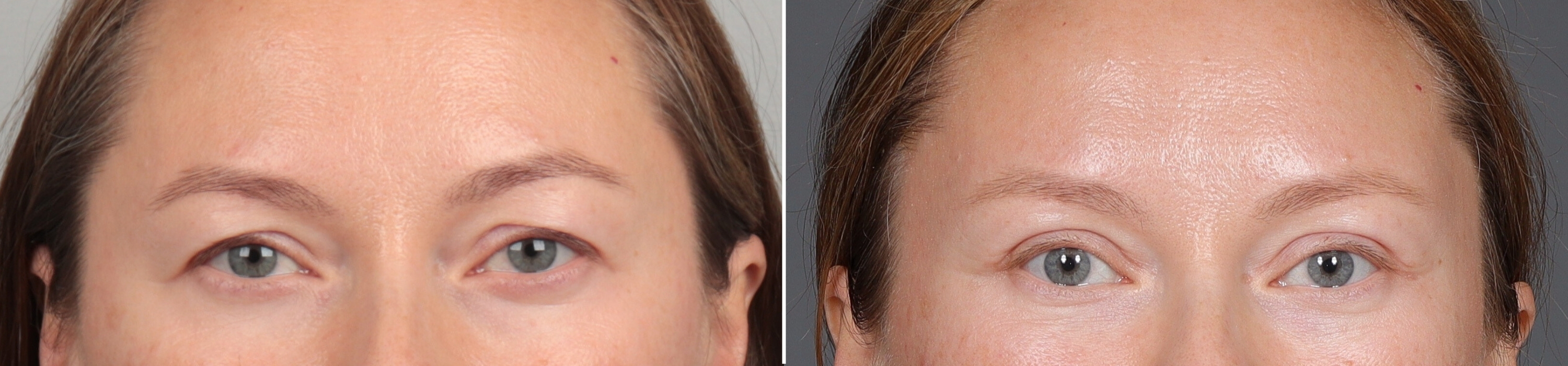
Featured Before / After
Upper Blepharoplasty & Brow Lift: 237