

How to Choose a Facelift Surgeon: 11 Things to Consider
I am a facelift surgeon in Toronto, Canada, and I should acknowledge at the outset that this is not a neutral position from which to write about choosing one. I have tried to separate what is verifiable from what is a matter of judgment, and to be clear about where my own practice shapes the advice.
Most of what is written about choosing a facelift surgeon concentrates on credentials, and credentials matter. But they are the easiest part of the decision to verify, and once verified they tell you very little about the operation you are going to receive. The questions that matter more are rarely addressed: whether the surgeon performs this operation often, which layer of the face they lift, and what they plan to do about your neck and your skin. Patients come to my practice from across Canada and from the United States, and those questions apply wherever you are.
This article is organized accordingly: a short section on verifying credentials and the surgical facility, followed by the questions that actually distinguish one surgeon from another. Where the advice reflects how I practise, I say so. It is general information rather than medical advice, and no article replaces an in-person assessment.
Verifying the basics
1. Confirm the certification, and what it is in
In Canada, specialist certification comes from the Royal College of Physicians and Surgeons of Canada. For plastic surgery that means a Royal College-accredited residency of at least five years followed by written and oral examinations. The letters FRCSC after a name mean the surgeon completed a Royal College surgical residency, but they are used across every surgical specialty, so an orthopaedic surgeon and a urologist carry the same letters. The question is not "are you certified?" but "what are you certified in?"
"Board-certified" is an American phrase that has migrated north through advertising. There is no Canadian board of cosmetic surgery, and the Royal College does not recognize cosmetic surgery as a specialty, so if a clinic uses the phrase, ask which board and in which specialty.
Every provincial college of physicians maintains a public register. In Ontario, where I practise, the College of Physicians and Surgeons of Ontario register is searchable by name or CPSO number and shows recognized specialties, registration status and history, hospital privileges, any restrictions on the licence, and any public notifications about discipline. Look for plastic surgery under specialties and nothing unexpected under restrictions. Patients from the United States will recognize the equivalent: certification by the American Board of Plastic Surgery, which requires a comparable residency and examination, and a state medical board licence lookup. My own Royal College certification in plastic surgery, my CPSO registration and my membership in the Canadian Society for Aesthetic Plastic Surgery can all be checked on a public register or directory in a couple of minutes. Beyond certification, I completed fellowship training in aesthetic plastic surgery at the University of Toronto with a focus on facial rejuvenation, and later taught within that program. Fellowship training is not regulated the way residency is, so any surgeon should be able to tell you where they trained, with whom, and what the training involved.
2. Confirm where the surgery happens
Where the surgery is performed matters as much as who performs it, and it is verifiable. In Ontario, any procedure performed outside a hospital under general anaesthesia, regional anaesthesia or intravenous sedation falls under the CPSO's Out-of-Hospital Premises Inspection Program. The premises must pass inspection before procedures can be performed there, the outcome of each inspection is published, and the program's standards require every physician operating in the premises to be appropriately qualified for the procedures they perform there, which for facelift surgery means certification pertinent to the operation or a formal CPSO change-of-scope process.
In practical terms, if the facility is CPSO-inspected and the surgeon's register entry says plastic surgery, the questions of licence, training and facility safety are largely answered. Other provinces run comparable non-hospital facility accreditation, and in the United States the equivalent is accreditation by AAAASF, AAAHC or The Joint Commission; in every case, ask for the facility's name and confirm it yourself. Ask the practice where your surgery will take place, look the facility up, and while you are asking, find out what monitoring is on site and what the team is trained to manage. Hospital privileges are not a requirement for cosmetic surgery and should not be treated as one. Cosmetic operations are performed in accredited private facilities rather than hospitals, and many surgeons whose practices are devoted to aesthetic surgery, including me, operate exclusively in that setting. What matters is that the facility is inspected and the surgeon is qualified to operate there.
Once those two checks are done, you have eliminated the risk that most articles on this subject are written about. What remains is the harder question, and the more important one.
What credentials do not tell you
Certification and inspection tell you a surgeon is qualified to operate. They tell you nothing about what operation you are going to get. Plastic surgery is a broad field covering hand surgery, burns, breast reconstruction and body contouring, and among fully certified plastic surgeons the range of what is called a "facelift" is enormous: from a skin-tightening procedure that lasts two years to a full release and repositioning of the deep structures of the face and neck. Two surgeons with identical register entries can be proposing entirely different operations. The rest of this article is about telling them apart.
3. Ask how much of their practice is facial surgery
Ask the direct question: how often do you perform facelifts, and what proportion of your practice is facial rejuvenation? No professional body publishes a minimum, but a surgeon who operates on faces every week thinks about facial anatomy, healing and complications differently from one who does the operation a few times a year between breast and body cases. My own practice is built around facial surgery and specifically around the deep plane facelift, and I would expect any surgeon to be able to describe their focus as plainly.
Ask about revision work separately. Operating on a face that has already been lifted means working through scar, altered blood supply and hairlines that have already moved. A surgeon who does revisions regularly, and who can explain clearly why a previous result fell short, understands the operation at a different depth. Plenty of good surgeons decline revisions, so treat this as context rather than a test.
4. Ask which layer they lift, and why
This is the most important question in the article, because it is where facelifts genuinely differ.
The skin is not what holds the face up. Beneath it sits a layer called the SMAS, the superficial musculoaponeurotic system, which is continuous with the platysma muscle in the neck. As the face ages, this layer and the fat pads attached to it slide downward, held back by a set of retaining ligaments. Everything you see as a jowl, a deepening fold beside the nose, or a heavy neck is that deeper layer descending.
Techniques differ in what they do about it. A skin-only or "mini" lift pulls the surface and leaves the descended layer where it is; it does not last and, pulled hard enough, produces the tight look people fear. Plication and SMAS techniques stitch or fold that deeper layer without fully releasing it from its ligaments. A deep plane facelift releases those ligaments and moves the skin and the deep layer together, as a single unit, back to where they sat before. The tissue is not stretched into a new position. It is returned to its old one, which is why the result can be substantial and still look like you.
I perform deep plane facelifts exclusively. That is a deliberate clinical choice rather than a marketing position, and I explain the reasoning in every consultation. Patients need not share my view, but they should expect any surgeon to explain which layer they are working on, why, and what that means for the longevity and naturalness of the result. A technique name on its own is not an explanation.
One caution: because deep plane surgery has become popular online, some practices now use the words without doing the operation. Ask the surgeon to describe what they actually release and reposition. The description should be about anatomy, not branding.
5. Ask what they will do about your neck
The neck is where facelifts most often disappoint, and it is the part many patients forget to ask about. Vertical bands, fullness under the chin and a blurred angle between chin and neck all come from the same descended platysma, and a facelift that addresses the cheek and leaves the neck alone produces a mismatch that ages badly.
Ask whether the neck is part of the plan, what will be done to the platysma, whether fat will be removed or repositioned, and whether the surgeon works on the neck from the front, from behind the ears, or both. The answer should be specific and anatomical. A general assurance that the neck will be tightened is not sufficient.
6. Ask what they will do about your skin and volume
A facelift moves tissue. It does not change the skin itself. Sun damage, fine lines around the mouth and eyes, pigmentation and texture are not corrected by lifting, no matter how well the lift is done, and a beautifully repositioned face with weathered skin still reads as older.
Practices handle this very differently. Some address skin months later, or not at all. In my practice, full-face laser resurfacing is performed at the same time as the facelift, including over the lifted tissue. That is possible because the deep plane flap is thick and well supplied with blood, which is what makes resurfacing safe on the same day. Whatever a surgeon's approach, they should have one, and they should tell you what the operation will not fix and how they plan to deal with it.
The same applies to volume. Faces lose fat with age, and repositioning tissue does not replace what is gone. Ask whether fat grafting is part of the plan and how it is used. I use it as an adjunct to surgery rather than a treatment on its own, and patients should understand that the proportion of grafted fat that survives varies and cannot be guaranteed.
7. Look at the photographs properly
Find patients who started where you are
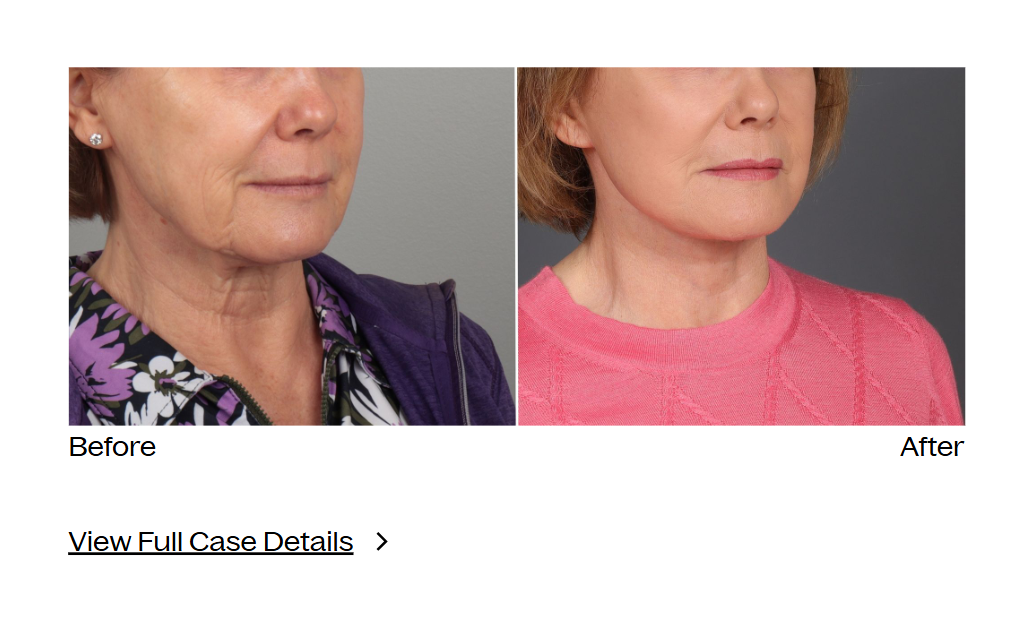
Ageing does not follow one pattern. Some faces lose volume and look hollow; others keep their volume and sag. Skin thickness, bone structure, sun exposure, weight history and genetics all change what an operation can do. A gallery of slender women in their fifties offers little guidance to a man in his late sixties with a heavy neck. Look for two or three patients who resemble your starting point.
Look at the details, not the whole face
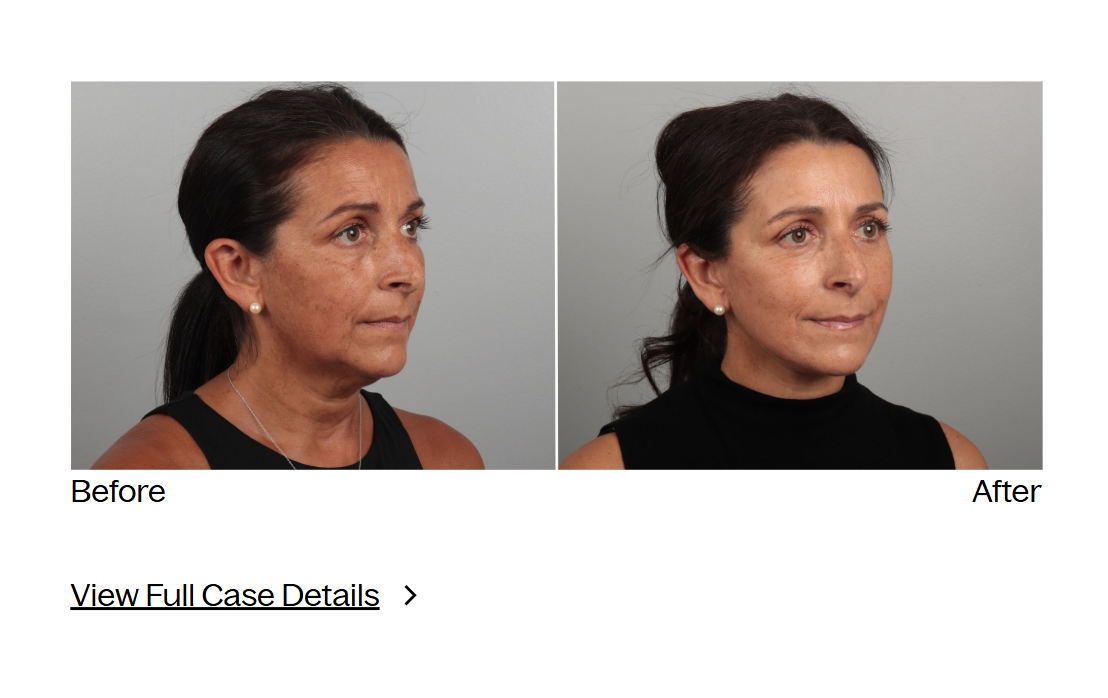
Technique shows in the details. Follow the jawline in the profile view and see whether it is a clean line. Look under the chin for bands and at the angle between chin and neck. Check the earlobes, which should hang naturally rather than being pulled forward or stretched. Follow the sideburn and the hairline in front of and behind the ear; they should be roughly where they began. Then find the scar, which in good hands sits in the crease in front of the ear and disappears into the hairline behind it. Consistent lighting, angles and framing make all of this easier to judge, and their absence is worth noticing.
Ask when the photographs were taken
Early photographs, at one to three months, are useful and show the direction of the result, but some swelling is still present and the tissue is still settling. Results at six months or later show what the operation delivers once that process is complete. Ask when the photographs were taken, and expect a practice that photographs its patients regularly to have both.
Decide whether their style is your style
Two skilled surgeons can produce different results from the same face. A consistent gallery tells you more than any single striking case: one great result may say more about the patient, but twenty results with a similar look tell you what this surgeon does. Say plainly what you are hoping for, point to specific photographs, and notice whether the surgeon engages with it or steers you back to their usual outcome.
8. Pay attention to how the consultation is run
A consultation is an examination, and how it is conducted tells you a great deal. Expect the surgeon to look at your skin quality and elasticity, the position of your cheek fat, the depth of the folds beside your mouth, the bands in your neck, the fat beneath your chin, your jawline and chin projection, your brows and eyelids, and how symmetrical your face is at rest and in motion. Expect questions about weight history, smoking, blood pressure, medications and supplements, previous surgery and how you heal. Expect standard photographs.
You should leave knowing what the operation will not do. A surgeon who tells you early that something you are worried about needs a different treatment, or no treatment, is giving you accurate information, and you should value it.
What you should not experience is pressure. Time-limited pricing, a push to book on the day, or a recommendation made before you have been properly examined are all reasons to slow down. And if you meet a patient coordinator and never the surgeon, you have not had a surgical consultation.
9. Find out who is in the room
Ask directly whether the surgeon you are meeting will perform the whole operation, and who else will be there. A facelift takes several hours. A trained assistant and a nursing team that knows facial surgery matter over that length of time. Ask who gives the anaesthetic and what type is planned; for an operation of this length it should be a qualified anaesthetist whose only job is your anaesthetic and your monitoring. Ask also whether you will stay overnight for observation or be sent home the same day. Most experienced facelift surgeons keep patients overnight with nursing care, because the first night is when a bleeding problem would declare itself, and that should be one of your criteria.
10. Ask about complications, recovery and after-hours care
Facelift surgery is safe in properly selected patients, and the complications that do occur are manageable when caught early. Bleeding under the skin, a hematoma, is the one most likely to require a return to the operating room. It usually appears within the first day, which is why patients are kept overnight for observation, and it occurs in fewer than one percent of cases; in my practice the haemostatic net has reduced that further. Temporary weakness or numbness from nerve irritation is infrequent, a few percent at most, and almost all of it resolves over weeks to months. Permanent nerve injury is extremely rare. Infection, poor scarring, hair loss near incisions, asymmetry and delayed healing are all possible but occur in a very small percentage of patients, mainly those with healing problems or who smoke.
Listen for whether the surgeon raises these before you do, and whether they describe a system: how they screen for blood pressure and blood-thinning medications, what happens if a problem develops overnight, whether the after-hours number reaches the surgeon or an answering service, and who would take you back to the operating room if it came to that.
Ask about drains. Traditionally, drains are placed under the skin to prevent fluid collecting and are removed at an early visit. I do not use them; a haemostatic net of fine sutures holds the skin against the underlying tissue for the first two to three days and leaves no marks. Neither approach is wrong, but a surgeon should be able to tell you which they use and why.
Then ask what recovery realistically looks like for the operation you have discussed: when swelling and bruising ease, when you can be seen in public, when you can return to work and exercise, and how long final settling takes. Ask how often you will be seen afterwards, by whom, and for how long. A practice that continues to see patients at six months and one year is positioned to identify issues the patient may not notice.
If you are travelling to Toronto from elsewhere, say so early. The first week is when problems show up, so agree in advance where you will stay, how long you should remain nearby, who examines you before you go home, and what happens if something needs attention after you have left.
11. Understand the cost
A cosmetic facelift is not covered by provincial health insurance or by most private plans, so you pay the full cost. A quote will typically state a surgical fee, which covers the surgeon, the nursing staff and the facility, and a separate anaesthesia fee. If the practice keeps patients overnight for observation, the overnight nursing is usually stated as well. Ask what is included in those figures: follow-up visits, garments, medications, and any additional procedures such as resurfacing, fat grafting or eyelid surgery that are part of the plan.
Price is a poor way to choose a surgeon. A quote well below others in the city may mean a smaller operation, a different facility or a less experienced surgeon; a high fee proves nothing on its own. What a quote does show is how the practice communicates.
Ask how long the surgeon follows patients after surgery and how they approach a result that needs adjustment. In my practice, revision is not considered until at least a year after surgery unless it is medically necessary, because the result is still evolving before that point. There is no standard answer, but the surgeon should have one.
Red flags
- Credentials you cannot find on the provincial or state register, or a facility whose accreditation you cannot confirm
- A surgeon who cannot tell you which layer they lift, or describes the operation only by its marketing name
- No plan for the neck, or no answer about the skin
- Very few facelift examples, or only tightly cropped photographs
- Pressure to book, or a price that expires
- Any guarantee of a specific result
- Risks mentioned only after you raise them
- Vague answers about who gives the anaesthetic
- No clear plan for after-hours problems or follow-up
Questions to bring to a consultation
- Are you certified in plastic surgery, and what is your registration or licence number?
- Where will the surgery take place, and who accredits or inspects that facility?
- How often do you perform facelifts, and how much of your practice is facial surgery?
- Which layer will you lift, and why is that the right approach for my face?
- What will you do about my neck?
- What will this operation not fix, and how do you address skin and volume?
- Can I see photographs of patients who started out like me, taken once the swelling has fully settled?
- Who gives the anaesthetic, and what type is planned?
- Will I stay overnight for observation, do you use drains, and what does the first week look like?
- What complications do you see, how do you handle them, and who do I call after hours?
- What does the quote include, and what is billed separately?
- How long do you follow patients after surgery, and how do you approach a result that needs adjustment?
Comparing surgeons afterwards
Two or three consultations give you something to compare; one gives you an impression with nothing to measure it against. Write your notes the same day. The credentials will usually be equivalent, so compare what is not: how much facial surgery each surgeon does, which layer each proposes to lift, what each plans for the neck and the skin, and whether the photographs included people like you. Where the plans differ, ask the second surgeon what they make of the first recommendation. The reasoning behind a disagreement will tell you how each of them thinks.
Then weigh the harder things. Whether you understood the explanation you were given, and whether you felt able to ask a follow-up question without the conversation speeding up. Confidence based on an explanation you understood is worth more than confidence based on the impression a practice creates.
If you'd like to speak with me about facelifts, please book a consultation here.
Frequently asked questions
Does the type of facelift matter when choosing a surgeon?
Yes, more than anything else once credentials are confirmed. The layer being treated determines how long the result lasts and how natural it looks. A lift that releases and repositions the deep layer, rather than tightening the skin over it, is a different operation with a different result.
How does verification differ between Canada and the United States?
In Canada, specialist certification comes from the Royal College and the term "cosmetic surgeon" is not regulated. In Ontario, a facility performing surgery under anaesthesia must pass CPSO inspection and the physicians operating there must be qualified for the procedures they perform. In the United States, look for American Board of Plastic Surgery certification and an accredited surgical facility, and be aware that other boards use similar language with different training requirements. In either country, the register is public and the check takes minutes.
How much facelift experience should a surgeon have?
No professional body publishes a minimum. What you can judge is how often they perform the operation, how much of their practice is facial surgery, and whether they can show consistent long-term results.
How many surgeons should I consult?
Enough to have a comparison, which usually means two or three. Ask the same questions at each appointment so the differences are easy to see.
How can I check a plastic surgeon's credentials?
Search the provincial college register by name for specialties, registration status, hospital privileges, restrictions and public notifications. Royal College certification can be confirmed through the Royal College directory, and the Canadian Society of Plastic Surgeons and the Canadian Society for Aesthetic Plastic Surgery both publish member directories. In the United States, the American Board of Plastic Surgery and each state medical board provide the equivalent lookups.
Should I choose a surgeon based on reviews?
Reviews tell you about the experience of care: communication, punctuality, how patients were treated during recovery. They are much weaker evidence of surgical skill, because patients cannot judge technique and review counts often reflect marketing effort. Use them as supporting information, not the deciding factor.
Is it practical to travel for facelift surgery?
Many patients do, from across Canada and from the United States. What matters is planning the first few weeks: where you will stay, how long you should remain in the city, who examines you before you go home, and who you contact afterwards. Surgeons who regularly treat out-of-town patients have a process for this.
What is the biggest red flag?
A surgeon who cannot tell you, in plain anatomical terms, what they are going to do to your face. Credentials you cannot check come a close second, but they are rare. An imprecise answer about the operation itself is far more common, and it is the one that most often leads to disappointing results.
Your Journey Starts With a Conversation
Schedule a personal consultation with one of our specialists and explore what’s possible, at your pace, in your way.